





About the project
Water utility providers across developing regions face a common operational challenge: billing is slow, error-prone, and disconnected. Field agents collect meter readings on paper, bring them back to the office, data entry teams manually process bills, and payments are tracked in spreadsheets. The gap between meter reading and bill delivery can stretch to weeks, causing revenue leakage, consumer disputes, and poor service quality.
The Challenge
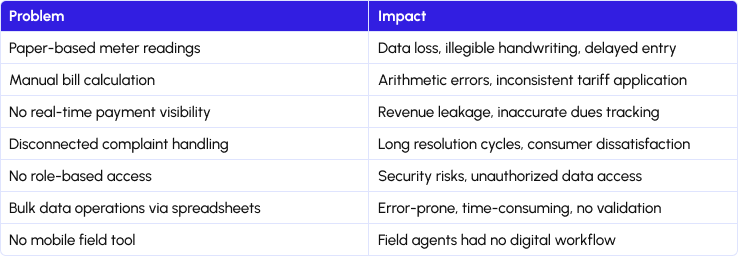
Municipal water billing, especially in tier-2 and tier-3 cities, has historically been managed through legacy processes:
The Approach
Water billing is a recurring, high-volume operation. A single urban utility can have tens of thousands of consumers billed monthly. Even a 2–3% improvement in payment collection efficiency translates to significant revenue recovery. The opportunity was identified across three dimensions:
- Operational Efficiency
- Revenue Recovery
- Scalability via SaaS
The Discovery
Water billing is a recurring, high-volume operation. A single urban utility can have tens of thousands of consumers billed monthly. Even a 2–3% improvement in p
- Operational Efficiency
- Revenue Recovery
- Scalability via SaaS
The Opportunity
Water billing is a recurring, high-volume operation. A single urban utility can have tens of thousands of consumers billed monthly. Even a 2–3% improvement in payment collection efficiency translates to significant revenue recovery. The opportunity was identified across three dimensions:
Execution Timeline
Water billing is a recurring, high-volume operation. A single urban utility can have tens of thousands of consumers billed monthly. Even a 2–3% improvement in payment collection efficiency translates to significant revenue recovery. The opportunity was identified across three dimensions:
- Operational Efficiency
- Revenue Recovery
- Scalability via SaaS